
The history of Mughal Invasion in India
- Aditi Matta
- Jun 18, 2024
- 4 min read

Indians have been trading with the Arabs for more than 4,000 years now. The trade relations date back to the Harappan civilization. The silk route is one of the most prominent sources of trade between the two. Arabs always had a keen interest in India due to the wealth acquired by the country. With them came their Islamic views and ideas to the East. After the death of Prophet Mohammed in 632 AD, the Arabs captured Persia and Hera, which was when they took an interest in capturing India along with other regions in the east.
In 712 A.D., under the leadership of Muhammad Bin Qasim, a ruler of the Umayyad Caliphate (Umayyad Dynasty ruler), Sindh, now a part of Pakistan was invaded making it an important event in the history of our country because it was the first time the Muslims had attacked India, and gained political supremacy to rule over the Indian territory. It wasn’t the first time there was an attempt to conquer Sindh but surely the first time it happened successfully. At the young age of 17, he defeated Dahir the ruler of Sind in the Battle of Rewar.
Though for a short duration, Qasim was the governor of Sindh until he died in 715 A.D. In the lands he conquered, Qasim instituted sound governance and law. There had been cases of impoverished Hindus being converted to Islam since he implied Jizya, a tax on non-Muslims which indirectly compelled the Hindus and Buddhists to convert.
After his death, the next ruler that changed the history of the Indian subcontinent was Mahmud of Ghazni. He was the first Turkish to invade India. In the south of Kabul, Ghazni, was where he ruled and further, he conquered a large part of Iran which was the west of Ghazni and then defeated the army of Raja Jayapala of the Kabul Shahis at the Battle of Peshawar on 28 November 1001. It was his third attempt in which he finally succeeded. In total, he made seventeen invasions into the wealthiest cities and temple towns of medieval India, including Mathura and Somnath, and took over them all. His main aim was to get wealthy while focusing on gaining entire control over Lahore, earlier known as Punjab for its highly fertile lands. Al-utbi mentioned in his work “Tarikh-e-Yamini” that Mahmud Ghaznavi destroyed a "great and magnificent temple" in Mathura.
It was common for the Islamic invaders to destroy and demolish Indian art and Hindu temples. Apparently when Mathura was attacked by Mahmud of Ghazni, "all the idols" were burnt and destroyed for twenty days, gold and silver were smelted for booty, and the city was burnt down. Mathura, being the richest city, then faced a decline in wealth. He was responsible for the breaking of the jyotilinga in Somnath Temple, Gujrat. Ghazni’s last invasion was in 1027, when he came to punish the Jats who hindered his way back from Somnath, he tortured them and took women and children as slaves. He died in 1030
During these invasions came Islamic scholars and preachers. Apart from the indirectly forced conversions by the ruler, these scholars preached and implied the principles of Islam and persuaded Hindus to convert. The thing was, the people did what the rulers asked out of them, they didn’t care about the religion so much as to survive with the surroundings. Ghazni was a significant ruler responsible for the downfall of Hinduism and the values of the Indians.
A big reason for the downfall of the Hindus at that time was the lack of unity, the social conditions prevalent during the wars were caste system. The caste system was blindly followed during this time and it was a major reason which led to the split and conversion of the population. Only the Kshatriyas went for wars and Brahmins enjoyed a special status and ultimately the Shudras were the ones who’d convert due to their economic status. No one from the other castes bothered to fight or get involved in the wars simply because they didn’t belong to the caste.
One positive thing was the state of women and education, women were free to choose a groom, there was no purdah system and they could own lands and wealth for themselves and they could also access education if they wished to.
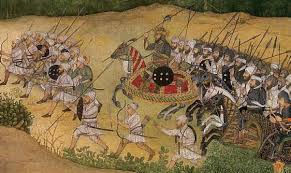
Then there was no prominent ruler until the end of the 12th century when the rise of Muhammed Ghori happened. He came with the vision and mission of looting India of all its wealth and spreading ISLAM. While Ghazi was the one who infiltrated India, ghori successfully managed to rule most of it. He ascended the Ghazi throne and attacked Punjab for the first time in 1186. His most famous battles were the First and Second Battle of Tarain which was first lost and then won by defeating Prithvi Raj Chauhan in 1192. He captured most of northern India this was the time when the state of temples changed.
The 12th century brought more damage to Buddhism than Hinduism, Buddhist scriptures were burned by the army, hundreds of Buddhist monasteries and shrines were demolished, and monks and nuns were executed.
The Buddhist University of Nalanda was mistaken for a fort because of the walled campus. The Buddhist monks who had been slaughtered were mistaken for Brahmins according to Minhaj-i-Siraj. The walled town, the Odantapuri monastery, was also conquered by his forces. Sumpa basing his account on that of Śākyaśrībhadra who was at Magadha in 1200, states that the Buddhist university complexes of Odantapuri and Vikramshila were also destroyed and the monks massacred. Forces attacked the north-western regions of the Indian subcontinent many times. Many places were destroyed and renamed. For example, Odantapuri's monasteries were destroyed in 1197 by Muhammad bin Bakhtiyar Khilji and the town was renamed. Likewise, Vikramashila was destroyed by the forces of Muhammad bin Bakhtiyar Khilji around 1200. Many Buddhist monks fled to Nepal, Tibet, and South India to avoid the consequences of war
The Islamic invaders had secured themselves an empire in the northern Indian subcontinent, probably the reason why India in the north and south have such different customs still. All of the Hindus in the north had to dwell according to the rules to survive in society. In contrast, in the south, there was freedom and more historical references available since there were not many temples destroyed there.

Comments